Study › Runes & Norse › The Elder Futhark

The Elder Futhark is the oldest runic alphabet: 24 runes, used for Proto-Germanic from about the 2nd century to the 8th. It is the row of runes most people mean when they say "runes" today.
What is the Elder Futhark?
The earliest runic alphabet, consisting of 24 runes. It was used for Proto-Germanic languages, and each rune had a phonetic value and often a symbolic meaning. Inscriptions are short, often found on portable objects such as jewelry and weapons, or on memorial stones.
Its name comes from its first six runes, f-u-th-a-r-k, and its runes fall into three families of eight, the ættir. The oldest inscription that is certainly runic, on the Vimose comb from Denmark, dates to around 160 CE, and the Kylver Stone on Gotland, from about 400 CE, lists the whole row in order. Barely 400 Elder Futhark inscriptions survive.
Where was the Elder Futhark used?
The Elder Futhark spread widely across Northern Europe — modern-day Scandinavia (Sweden, Norway, Denmark), Germany, and parts of the Netherlands and Poland. Its heartland lay in southern Scandinavia (Denmark and southern Sweden) and northern Germany, along the North Sea coast. Scattered finds reach the British Isles and as far east as Ukraine, carried there by Gothic migrations. Only about 350 Elder Futhark inscriptions survive, some 260 of them in Scandinavia; together with Frisia this core forms the so-called North Sea Germanic runic koine, with Denmark the richest in finds.
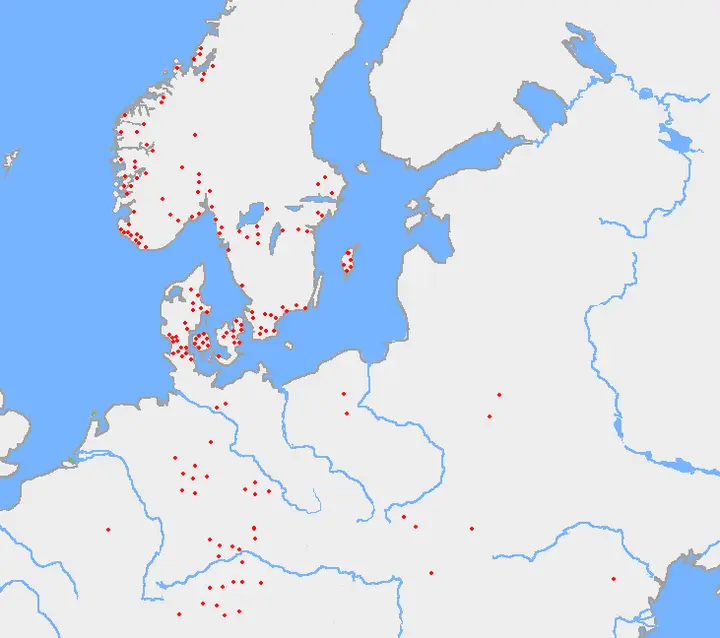
It gave way to the Younger Futhark in Scandinavia and the Anglo-Saxon Futhorc in England. Its first rune is Fehu.
Questions
How many runes are in the Elder Futhark?
24, in three families of eight called ættir.
How old is the Elder Futhark?
The oldest certain inscription, on the Vimose comb, dates to about 160 CE.
Why is it called futhark?
From the sounds of its first six runes: f, u, th, a, r, k.