Study › Runes & Norse › The Wheel of the Year
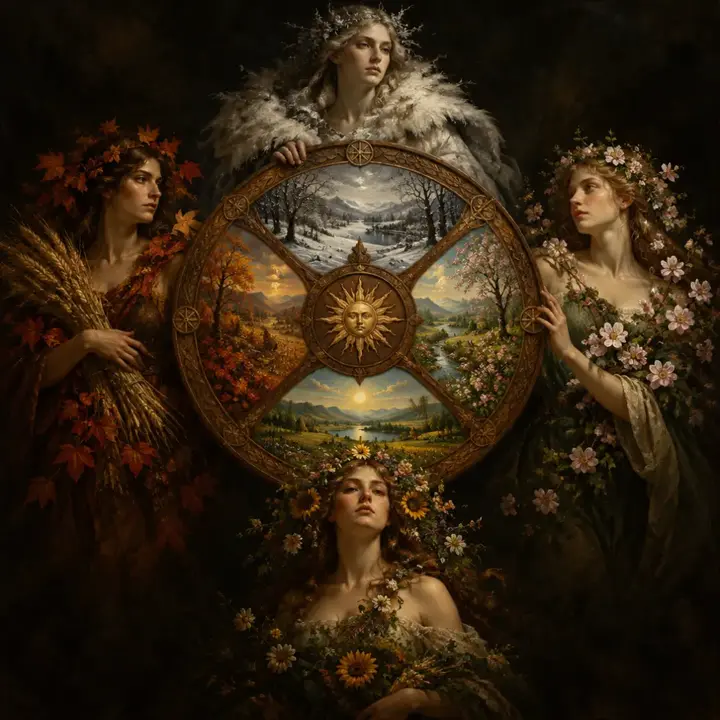
The Wheel of the Year is the cycle of eight festivals many modern pagans keep: the solstices, the equinoxes and the four days between. It is a 20th-century calendar, but each festival has a Norse counterpart, and three were great Norse sacrifices.
What is the Wheel of the Year?
The Wheel of the Year is the cycle of eight festivals that many modern pagans keep: the two solstices, the two equinoxes, and the four days that fall between them. It is not an ancient calendar. It was brought together in the 1950s by Gerald Gardner, founder of Wicca, and Ross Nichols, founder of a Druid order, and several of its festival names — Ostara, Litha and Mabon — were only given in 1974.
The Norse feasts
The Ynglinga saga names three great sacrifices in the year: one toward winter for a good year, one at midwinter, and one in summer for victory. We know them as Vetrnætr, Jól and Sigrblót. Modern heathens, beginning in the 1970s, filled in the rest of the wheel with Norse feasts, so that each of the eight has a Norse counterpart.
The festivals and their energies
The pages that follow give each festival by its Norse name, with the better-known name beside it, and say plainly which are old and which are new. Old or new, each one marks a real turn of the year — the light returning, the land waking, the harvest, the dark coming in — and each is a moment to work with the energy of that turn.
Its midwinter feast is Jól, or Yule.
Questions
Is the Wheel of the Year ancient?
No. It was put together in the 1950s; some of its names date from 1974.
Which Norse feasts are old?
Vetrnætr at the start of winter, Jól at midwinter, and Sigrblót in summer.