Study › Runes & Norse › The Jelling Stones
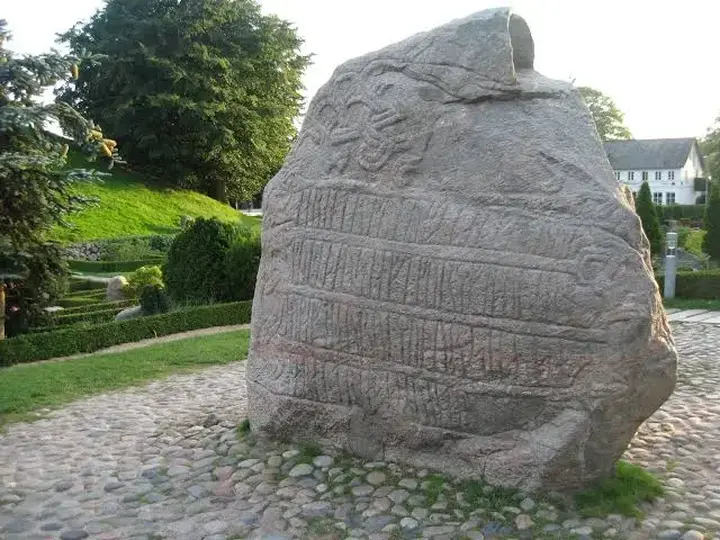
The Jelling Stones are two great runestones in Jelling, Denmark, raised by King Gorm the Old and his son Harald Bluetooth in the 10th century. They are called Denmark's birth certificate.
What are the Jelling Stones?
The Jelling Stones are among the most famous Viking Age monuments in Scandinavia and are often called Denmark's birth certificate. They stand in the village of Jelling, Jutland, Denmark, and consist of two stones: the smaller raised by King Gorm the Old around 950 CE, and the larger erected by his son King Harald Bluetooth around 965 CE. The larger stone records Harald's claim that he united Denmark and introduced Christianity to the Danes, and the surrounding monument complex of burial mounds and a church is a UNESCO World Heritage Site. The Great Jelling Stone measures approximately 2.43 meters high and weighs about 10 tonnes. It is carved on three sides with runic inscriptions and artwork, including one of the earliest large-scale Scandinavian depictions of Christ.
Harald's initials are the Bluetooth logo. The stones are carved in the Younger Futhark.
Questions
Who raised the Jelling Stones?
King Gorm the Old the smaller, around 950, and his son Harald Bluetooth the larger, around 965.
Why are they called Denmark's birth certificate?
The larger stone records Harald's claim that he united Denmark and made the Danes Christian.