Study › Runes & Norse › Funerals and Ship Burials
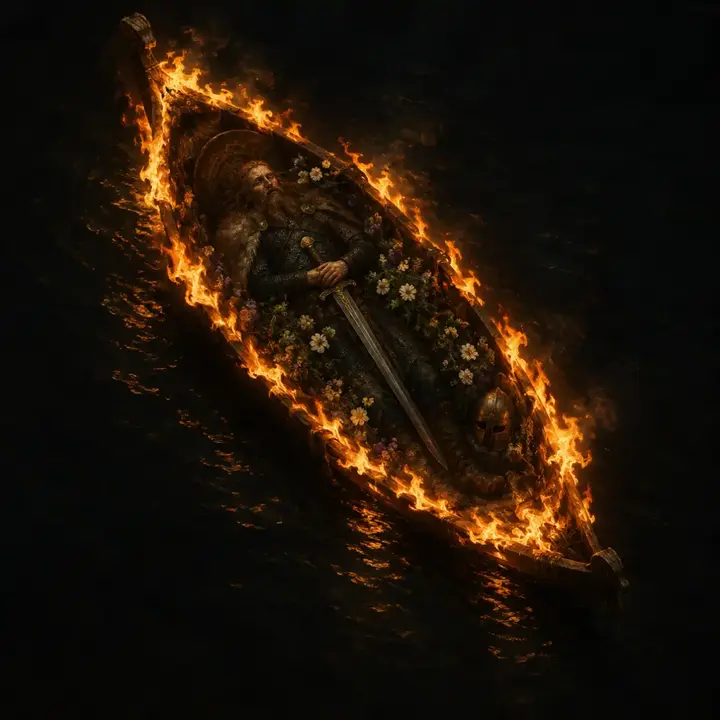
A Viking funeral gave the dead a journey. Some were burned, some buried, and the greatest were laid in a ship, as if setting out to sea, with the things they would need.
What was a Viking funeral?
The Norse gave their dead a journey. Some were burned on a pyre, some laid in the earth, and the greatest were buried or burned in a ship, as if setting out to sea. Around them were placed what they would need: weapons, jewellery, food, tools, animals and, at times, servants.
The great ship burials
The Oseberg ship in Norway, buried in the year 834, held two women with a richly carved ship, a wagon, sledges, beds, horses and dogs. The Gokstad ship, buried around 900, held a man with a ship built to sail the open sea. Where no ship could be spared, the dead were laid inside stones set in the shape of a ship, as at Lindholm Høje in Denmark.
Ibn Fadlan's account
The Arab traveller Ibn Fadlan witnessed the funeral of a chieftain of the Rus on the Volga in 922: the man was laid in his ship with his goods and burned, and a great mound was raised over the ashes. One of the Rus told him that his people burned their dead so that they would go at once to paradise, rather than be left to rot in the earth.
The dead of battle hoped for Valhalla; others went to Helheim.
Questions
Did Vikings burn their dead in ships?
Some were burned in ships, as Ibn Fadlan saw on the Volga; others, like the Oseberg women, were buried in them.
What is the Oseberg ship?
A richly carved ship buried in Norway in 834 with two women.