Study › Runes & Norse › Holmgang
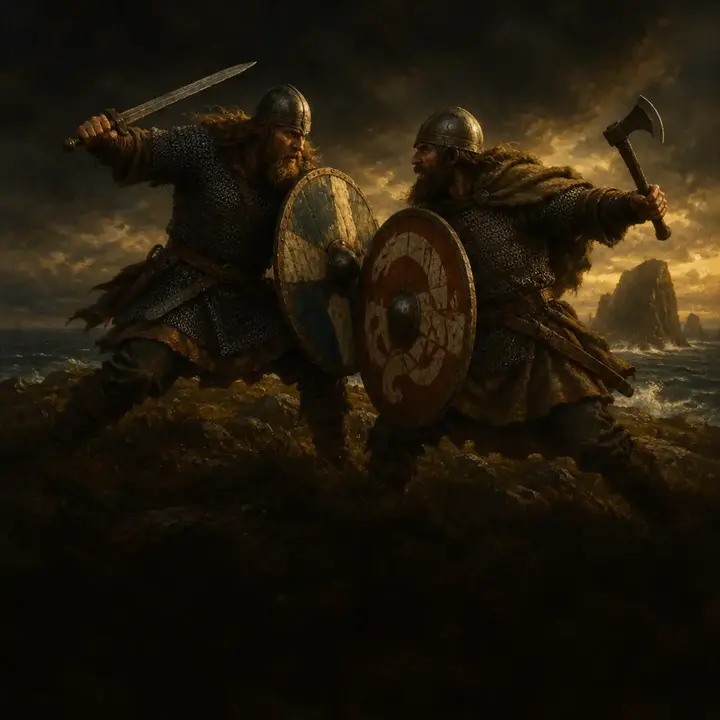
The holmgang was a Viking duel fought under law to settle a dispute, often on a small island. The Saga of Kormak gives its rules: a cloak pegged to the ground, three shields each, and blows in turn.
What was a holmgang?
The holmgang was a duel fought under law, to settle a dispute that the courts and witnesses could not. Its name, 'going to the islet', comes from the custom of fighting on a small island, where no one could interfere and neither man could run.
The rules of the holmgang
The Saga of Kormak describes its rules. A cloak or hide five ells square was pegged to the ground with loops and stakes, and three furrows were marked around it. Each fighter had three shields. They struck in turn, the one who was challenged taking the first blow. A man who stepped off the cloak with one foot was said to yield ground; with both feet, to flee. The first to bleed onto the cloak could stop the fight by paying a ransom of silver.
A judgement of the gods
The duel was seen as a judgement of the gods, who would give victory to the one in the right. A man who was challenged and did not come was declared a níðingr, a man without honour. Iceland is said to have banned the holmgang in the early 11th century, after a famous duel between two poets fighting over a woman.
It was a judgement of the gods; the god of law and oaths is Tyr.
Questions
What does holmgang mean?
"Going to the islet", from the custom of fighting on a small island.
When was the holmgang banned?
Iceland is said to have banned it in the early 11th century.