Study › Runes & Norse › Berserkers and Wolf-Warriors
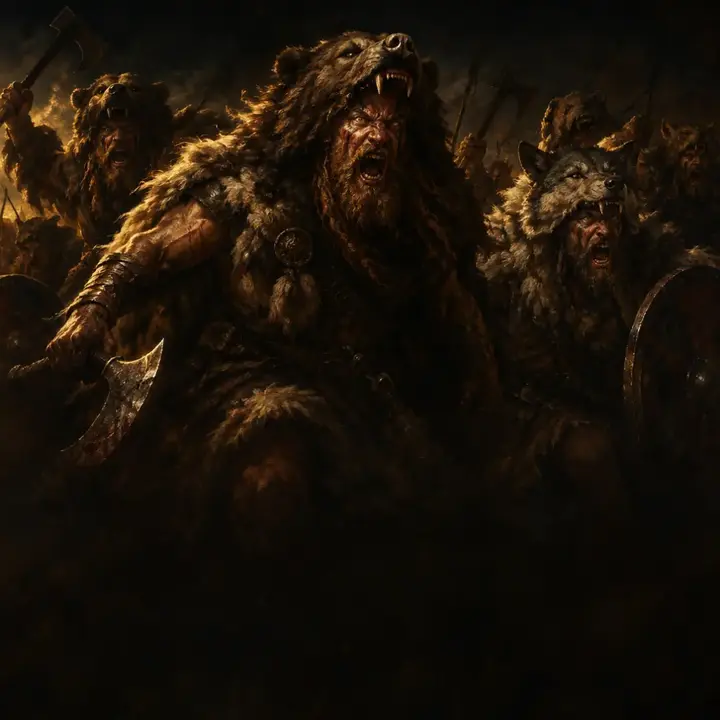
Berserkers were Viking warriors of Odin who fought in a wild frenzy, without armour, biting their shields. The word is usually read as "bear-shirts". A second band, the ulfhednar, wore wolf skins.
What were berserkers?
The berserkers were warriors of Odin who fought in a frenzy. Their name is usually understood as 'bear-shirts', and a second band, the ulfhednar, the 'wolf-hides', wore the skins of wolves. Snorri describes Odin's men going to battle without mail, mad as dogs or wolves, biting their shields, strong as bears or bulls. They killed men, and neither fire nor iron could hurt them.
Going berserk
That fury was called berserksgangr, 'going berserk'. In the sagas berserkers often serve kings as bodyguards, but they also appear as bullies who roam the country challenging farmers to duels to take their land or women, and the hero's task is often to defeat them.
Berserkers after the Viking Age
Some of the famous Lewis chessmen, carved in the 12th century, show warders biting the rims of their shields, just as the old descriptions say — a sign of how well known the berserker's rage still was long after the Viking Age.
They were the warriors of Odin, and the fallen among them hoped for Valhalla.
Questions
What does berserker mean?
It is usually read as "bear-shirt", from the bear skins they are said to have worn.
Who were the ulfhednar?
The "wolf-hides": warriors like the berserkers, who wore the skins of wolves.
Were berserkers real?
They appear in Viking Age poems and in the sagas as real warriors. How their fury worked, and how much of it was legend, historians still debate.